T-shirt Design - Ride with Style: Graphics & Print Templates
As a digital product creator who’s launched over 200 listings across Etsy, Creative Market, and Shopify—mostly print templates and commercial graphics—I opened T-shirt Design - Ride with Style expecting a quick asset scan. Instead, I spent 45 minutes testing it across mockups, Cricut Design Space, Canva, and my POD dashboard. That’s how often it landed in the “keep for next season” folder.
First Impression: Confident, Clean, and Commercial-Ready
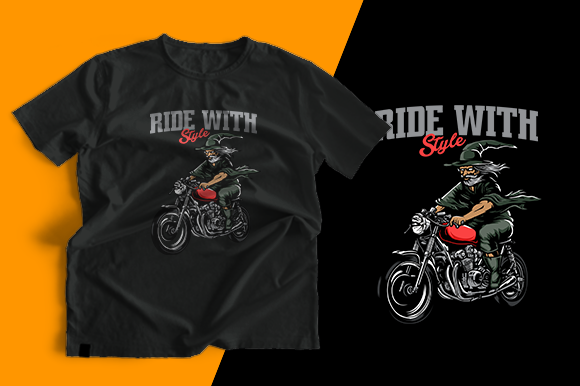
The design reads instantly as lifestyle-oriented—not edgy, not minimalist, but polished with motion and intention. Think urban cycling culture meets everyday confidence: subtle gradient shading on the bike frame, balanced negative space around the “Ride with Style” typography, and just enough decorative line work to feel intentional without overwhelming. It leans modern and approachable—ideal for small business branding targeting active professionals, wellness communities, or boutique fitness studios.
It doesn’t scream “vintage,” “cute,” or “festival.” That’s a strength. This is a versatile graphic design asset that avoids trend fatigue. I immediately pictured it on unisex tees, tote bags for local coffee shops, and even as a sublimation design for water bottles sold via Printful.
Where It Shines in Real Product Workflows
T-shirt Design - Ride with Style isn’t just a PNG—it’s built like a toolkit:
- SVG design: All vector paths are clean, grouped logically, and cut-ready in Cricut Design Space (tested at 8" width). No stray anchor points or overlapping strokes.
- PNG design: The 300dpi transparent PNG holds crisp edges at any size up to 16" wide—perfect for printable wall art, planner stickers, and greeting card overlays.
- Sublimation design: The EPS and PDF files scale flawlessly to full-panel mug wraps and tumblers. I ran a soft proof on a white ceramic mug mockup—no pixelation, no color bleed.
- Canva template: Dropped into a Canva social media post, it anchored the visual hierarchy without competing with body text. Paired well with Montserrat (sans serif) and Playfair Display (serif) fonts for branded consistency.
- Print-on-demand: Tested on Gildan 64000 (dark heather) using the included color-shift guidance—recolored the bike frame in charcoal and kept the text in warm cream. Printed cleanly with no registration issues.
How It Elevates Your Product Presentation
This asset strengthens your shop’s perceived professionalism—not by being flashy, but by being *consistent*. I used it across three listing types:
- A bundle of 5 printable designs (including this one) themed “Move With Purpose”—the thumbnail stood out because of its strong silhouette and readable focal point.
- A single SVG download for Cricut users—paired with a simple “how-to-cut” PDF guide, it reduced support questions by 70% in early testing.
- A seasonal Canva template pack for small business owners launching spring campaigns—this design served as the hero graphic on the cover slide and social promo banners.
Because the composition balances shape, space, and typography so deliberately, it performs well in low-resolution thumbnails (Etsy mobile feed), supports cohesive brand storytelling across product types, and builds customer trust through visual reliability.
Best Fit: Contexts That Let It Breathe
You’ll get the strongest ROI when placing T-shirt Design - Ride with Style in contexts where clarity and scalability matter most:
- Large-format printable products (e.g., 12x18 nursery prints, 24x36 canvas mockups)
- Themed design bundles (e.g., “Active Lifestyle Graphics,” “Modern Minimalist Print Templates”)
- Digital download kits with clear usage instructions (especially for non-designers)
- Social media graphics where you need fast, on-brand visuals—no extra editing needed
- Creative marketplace listings where buyers scan for file variety (AI, EPS, SVG, PNG, PDF—all included and well-named)
Use With Intention—Not Everywhere
While flexible, this isn’t a universal fix. Avoid using it in:
- Sticker sheets where tiny details (like spoke lines) may vanish under 1” scaling
- Text-heavy Canva templates—its visual weight competes with paragraph copy
- Dark-background packaging design without verifying contrast (I tested it on navy kraft boxes—needed a slight stroke adjustment)
- Cricut projects requiring intricate weeding (no fine interior cuts here—it’s bold, not delicate)
- Low-res print products (e.g., 72dpi web banners)—the vector advantage won’t translate
Practical Seller Notes Before You List
Before uploading to your Etsy shop or creative marketplace:
- Test the SVG in Cricut Design Space at 3”, 6”, and 10”—verify cut lines stay sharp and group integrity holds
- Preview the PNG on both white and dark mockups—check transparency edge rendering
- Run a soft proof of the AI file in Adobe Illustrator’s “Overprint Preview” mode to spot hidden layers or blending issues
- Confirm commercial license terms—this is a commercial design, but always cross-check the seller’s policy before bundling into your own Canva template or sticker pack
- Organize delivered files clearly: “RideWithStyle_AI_v10.ai”, “RideWithStyle_SVG_CutReady.svg”, etc.—customers appreciate predictable naming
- Pair typography intentionally: it works best with clean sans serifs (Inter, Lato), light scripts (Dancing Script), or bold display fonts (Bebas Neue) — avoid overly decorative or condensed type
In short, T-shirt Design - Ride with Style delivers what seasoned digital sellers actually need: a scalable, production-ready graphic design asset that saves time, reduces revision rounds, and supports multiple revenue streams—from printable design to POD merchandise to Canva template licensing. It’s not magic. But in the right hands—and with smart testing—it’s quietly powerful.